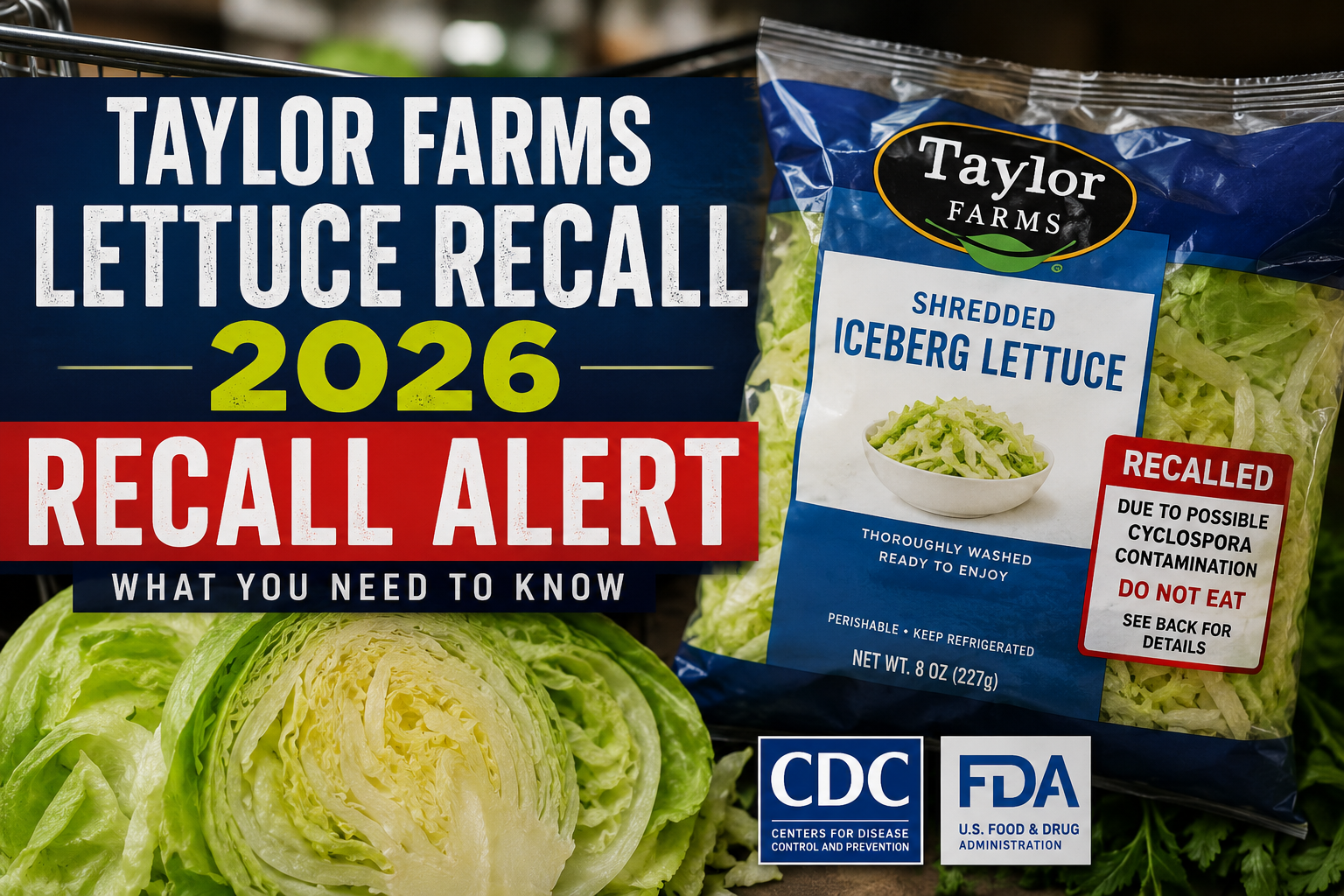
If you recently purchased packaged lettuce or salad products, it’s time to take a closer look at what’s in your refrigerator. The Taylor Farms Lettuce Recall 2026 has become one of the most significant food safety alerts this summer after federal health officials linked certain iceberg lettuce products to a Cyclospora outbreak affecting consumers in multiple states.
The investigation, led by the Centers for Disease Control and Prevention (CDC) and the U.S. Food and Drug Administration (FDA), continues as officials work to identify all potentially affected products and prevent additional illnesses. Because many grocery stores sell lettuce under their own private labels, consumers may not immediately realize that the product they purchased could be included in the recall.
Cyclospora infections can cause prolonged gastrointestinal illness, and symptoms often don’t appear immediately. In many cases, people may not become sick until two days to two weeks after eating contaminated food, making it difficult to connect the illness to a specific meal.
In this guide, you’ll learn:
- Why the Taylor Farms lettuce recall was announced
- Which products may be affected
- Which states received the recalled lettuce
- Symptoms of Cyclospora infection
- What to do if you purchased the recalled product
- How to protect yourself and your family
Whether you recently bought shredded lettuce, bagged salad, or iceberg lettuce for sandwiches, tacos, or burgers, it’s worth taking a few minutes to verify whether your purchase may be affected.
Taylor Farms Lettuce Recall 2026: Why Was It Announced?
Taylor Farms de Mexico voluntarily recalled certain iceberg lettuce products after investigators found evidence linking them to a Cyclospora cayetanensis outbreak. Federal investigators identified illnesses reported in several states and began tracing the source through patient interviews and food distribution records.
Cyclospora is a microscopic parasite that contaminates fresh produce through contaminated water or other environmental sources. Because fresh lettuce is typically eaten raw rather than cooked, any contamination may survive until the food is consumed.
The CDC and FDA continue investigating the outbreak while working with distributors, retailers, and public health agencies to determine the full scope of affected products. As new information becomes available, additional products or locations could be added to the recall.
Although many consumers associate food recalls with bacteria such as Salmonella or E. coli, Cyclospora outbreaks have become increasingly common in recent years because the parasite can spread through fresh fruits and vegetables that are eaten without cooking.
What Products Are Included in the Recall?
The recall primarily involves iceberg lettuce products supplied by Taylor Farms de Mexico. These products were distributed to retailers, restaurants, and food-service companies before being sold to consumers.
Affected products may include:
- Marketside Fresh Cut Shredded Iceberg Lettuce
- Marketside Classic Iceberg Salad
- Packaged iceberg lettuce
- Shredded lettuce used for sandwiches and tacos
- Additional private-label salad products supplied by Taylor Farms de Mexico
Because grocery stores often sell identical products under different store brands, consumers should not rely solely on the package’s front label. Instead, review the official FDA recall notice and compare the product information, purchase date, and retailer.
If you no longer have the original packaging and believe you may have purchased one of the recalled products, health officials recommend discarding the lettuce rather than taking the risk of eating it.
States Potentially Affected
According to federal health officials, the recalled lettuce was distributed to multiple states through grocery stores, wholesalers, restaurants, and food-service suppliers.
Although the investigation remains active, consumers across the United States should pay attention to updates because distribution networks often cross state lines. A product purchased in one state may have been processed or distributed through another region before reaching store shelves.
If you recently purchased packaged lettuce from a major grocery retailer—including Walmart or stores carrying private-label salad products—it is worth checking whether your purchase matches the recall information.
Even if your state has not reported confirmed illnesses, public health officials recommend remaining cautious until the investigation is complete.
Cyclospora Symptoms: What to Watch For
One reason the Taylor Farms lettuce recall is receiving so much attention is that Cyclospora infections often take days to appear. Unlike some foodborne illnesses that begin within hours, symptoms usually develop between 2 and 14 days after eating contaminated food.
Common symptoms include:
- Frequent watery diarrhea
- Loss of appetite
- Stomach cramps
- Bloating and gas
- Nausea
- Fatigue
- Low-grade fever
- Weight loss from prolonged illness
Some people experience symptoms for several weeks if they are not diagnosed and treated. Others may feel better for a short period before the illness returns.
While healthy adults usually recover, older adults, young children, and people with weakened immune systems may experience more severe or prolonged illness.
If you recently ate recalled lettuce and begin experiencing these symptoms, contact your healthcare provider. Laboratory testing is often needed because Cyclospora infections cannot be diagnosed based on symptoms alone.
What Should You Do If You Purchased the Recalled Lettuce?
If you believe you purchased one of the recalled products, health officials recommend taking action immediately.
1. Do Not Eat the Product
Even if the lettuce looks and smells normal, it may still be contaminated. Cyclospora cannot be seen with the naked eye.
2. Throw It Away
Dispose of the recalled lettuce in a sealed trash bag so it cannot accidentally be consumed.
3. Clean Your Refrigerator
Wash any shelves, drawers, or containers that came into contact with the lettuce using hot, soapy water. Cross-contamination can occur if contaminated juices spread to other foods.
4. Watch for Symptoms
Monitor your health for up to two weeks after eating the product. Because symptoms may not appear immediately, don’t assume you’re in the clear after just a day or two.
5. Contact Your Healthcare Provider
If diarrhea lasts more than a couple of days or becomes severe, seek medical care. Cyclospora infections are treatable with prescription antibiotics when diagnosed.
How the CDC and FDA Are Responding
The CDC and FDA continue working with state health departments to identify additional illnesses and determine exactly how contaminated lettuce entered the supply chain.
Investigators are reviewing:
- Patient interviews
- Distribution records
- Product tracing
- Laboratory testing
- Retail and restaurant supply chains
Because investigations evolve, the official recall list may expand if additional products are linked to the outbreak.
Consumers should continue checking the FDA recall database and CDC outbreak updates for the latest information.
Food Safety Tips to Reduce Your Risk
Although no food safety practice completely eliminates the risk of contamination, these habits can help lower your chances of foodborne illness.
- Purchase fresh produce from reputable retailers.
- Refrigerate lettuce promptly after purchase.
- Wash your hands before handling food.
- Separate raw produce from raw meat and poultry.
- Clean cutting boards and kitchen surfaces regularly.
- Pay attention to food recall announcements.
- Discard recalled foods immediately instead of trying to wash or salvage them.
Remember that washing lettuce may remove dirt but does not reliably eliminate Cyclospora parasites. Consumers should continue following updates about the Taylor Farms Lettuce Recall 2026.
Frequently Asked Questions
Is washing the recalled lettuce enough?
No. Health officials recommend throwing away recalled lettuce instead of washing it because Cyclospora may remain on the produce.
Can cooking kill Cyclospora?
High cooking temperatures can destroy many parasites, but iceberg lettuce is almost always eaten raw, making recalls especially important.
How long after eating contaminated lettuce do symptoms begin?
Symptoms generally appear between 2 and 14 days after exposure.
Is Cyclospora contagious?
Cyclospora is generally not spread directly from person to person. Most infections occur after consuming contaminated food or water.
Can I get a refund?
Many retailers provide refunds for recalled food products. Check with the store where you purchased the lettuce and keep your receipt if possible.
FDA:
https://www.fda.gov/safety/recalls-market-withdrawals-safety-alerts
CDC:
https://www.cdc.gov/foodborne-outbreaks/index.html
Final Thoughts
The Taylor Farms Lettuce Recall 2026 serves as another reminder that food recalls can affect products found in millions of American kitchens. Because packaged lettuce is commonly used in sandwiches, tacos, burgers, wraps, and salads, consumers should carefully review recent purchases and follow guidance from federal health officials.
If you have any recalled lettuce in your refrigerator, the safest option is to throw it away immediately, clean any surfaces it touched, and monitor for symptoms over the next two weeks. As the CDC and FDA continue their investigation, staying informed and acting quickly can help protect you and your family from foodborne illness.
Concerned about other food safety alerts? Read our Egg Recall 2026: Check If Your Carton Is Affected for the latest updates.
Leave a Reply